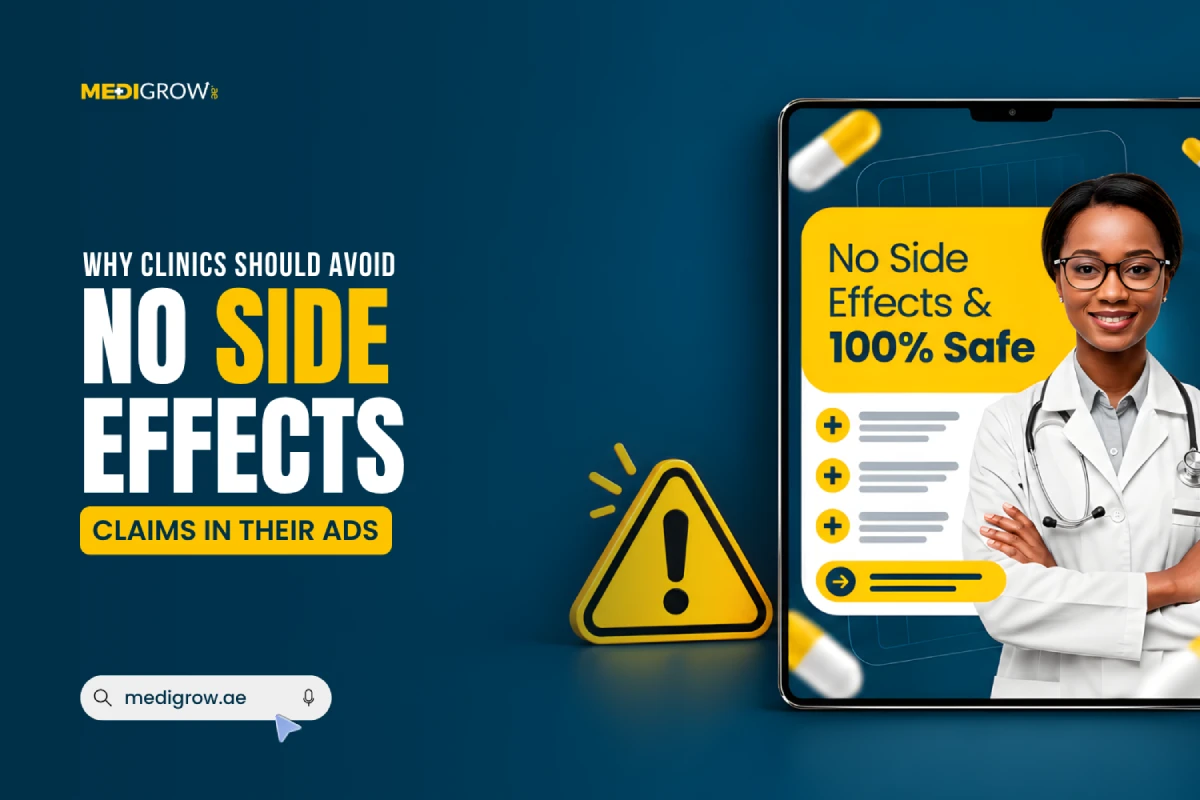
Healthcare advertising in Dubai requires more than persuasive marketing it requires careful, accurate, and responsible communication. Claims such as “no side effects,” “100% safe,” “risk-free,” or “guaranteed results” may attract attention, but absolute statements can create unrealistic expectations and may raise healthcare advertising compliance concerns.
For Dubai clinics, wording in Google Ads, social media campaigns, websites, landing pages, brochures, and other promotional materials should accurately reflect the treatment, its potential benefits, limitations, risks, and expected outcomes. Medical results can vary from one patient to another, so broad promises require careful review.
In this guide, we explain why clinics should be cautious with absolute medical claims, highlight common examples, and provide more balanced ways to communicate treatment information while maintaining clarity, credibility, and patient trust.
Why Should Clinics Avoid “No Side Effects”?
Every medical treatment, procedure, medication, or intervention can have potential risks or side effects. These may differ depending on the patient’s medical history, age, existing conditions, medications, treatment method, and individual response.
Using a statement such as “No Side Effects” suggests that a treatment is completely free from risk for every patient. In practice, healthcare professionals cannot generally guarantee this outcome.
Similarly, phrases such as “100% safe,” “risk-free,” “guaranteed results,” or “zero complications” can create unrealistic expectations.
Instead of making absolute promises, clinics should use accurate and patient-focused language that reflects the individual nature of healthcare.
For example, rather than saying:
“This treatment has no side effects.”
A clinic could say:
“Your doctor will discuss the potential benefits, risks, and side effects before treatment.”
This provides useful information without making an absolute promise.
Common Types of Claims Clinics Should Be Careful With
“No side effects” is not the only type of wording that can be problematic in healthcare advertising. Clinics should review advertisements for claims that may appear exaggerated, misleading, or impossible to guarantee.
Examples include:
- 100% safe treatment
- No side effects
- Guaranteed results
- Permanent results
- Risk-free procedure
- Instant results
- Miracle treatment
- Zero complications
- Best doctor in Dubai
- Guaranteed cure
The concern is not simply the individual words. The overall meaning and context of the advertisement matter.
For example, saying that a doctor provides “advanced treatment for acne scars” is very different from saying that the treatment will “completely remove acne scars permanently with zero side effects.”
The second statement makes several absolute promises that may not be appropriate for every patient.
What Can Clinics Say Instead?
Medical advertisements should be reviewed carefully for claims that may overstate safety, effectiveness, outcomes, or patient expectations. The wording below illustrates common examples that Dubai clinics should consider reviewing and more balanced alternatives that communicate information without making absolute promises.
Claim to Review | Why It May Be Problematic | More Balanced Alternative |
“No side effects” | Suggests that the treatment carries no risk for any patient, which may create unrealistic expectations. | “Your doctor will explain the potential benefits, risks, and side effects before treatment.” |
“100% safe” | An absolute safety statement may imply that complications or adverse reactions are impossible. | “Your doctor will assess whether the treatment is suitable for you and explain its potential risks and benefits.” |
“Risk-free procedure” | May give patients the impression that there are no possible risks associated with the procedure. | “Potential risks and recovery expectations will be discussed during your consultation.” |
“Guaranteed results” | Implies that every patient will achieve a particular outcome regardless of individual circumstances. | “Treatment plans are tailored to individual patient needs and goals, and results may vary.” |
“Permanent results” | May create an expectation that results will last indefinitely in every patient. | “The duration of results can vary depending on the treatment and individual circumstances.” |
“Zero complications” | Suggests that complications are impossible, which can create unrealistic expectations. | “Your doctor will discuss the potential risks and complications associated with the procedure.” |
“Guaranteed cure” | Implies a definite medical outcome and may be misleading where outcomes depend on individual patient factors. | “Your doctor can discuss available treatment options and the expected outcomes based on your individual condition.” |
“Miracle treatment” | Promotional language can exaggerate the effectiveness of a treatment and create unrealistic expectations. | “An advanced treatment option that may be suitable for selected patients.” |
“Best doctor in Dubai” | A superlative claim may require appropriate substantiation and should be considered in the context of applicable advertising requirements. | “Experienced [specialty] physician providing [specific treatment/service].” |
“Instant results” | May suggest that patients will experience immediate outcomes when results may take time to develop. | “Results and the expected timeline will vary depending on the treatment and individual patient response.” |
Where Should Clinics Check Their Advertising Language?
A clinic’s promotional content may appear in many places, including:
- Google Search and display advertisements
- Social media advertisements
- Instagram and Facebook posts
- Clinic websites
- Landing pages
- Brochures and flyers
- Outdoor advertising
- Promotional videos
- Email and WhatsApp campaigns
A claim that appears harmless on a website can still create concerns when repeated in a paid advertisement or promotional campaign.
For this reason, clinics should review all patient-facing marketing content, not just their Google Ads.
Why Accurate Medical Advertising Builds Trust
Compliance is only one reason to avoid exaggerated claims. Honest healthcare communication also helps build long-term patient trust.
Patients increasingly research doctors, clinics, procedures, and treatments before booking an appointment. If an advertisement promises perfect results but the consultation presents realistic risks and limitations, patients may feel misled.
Clear language sets better expectations from the beginning.
A strong healthcare advertisement does not need to promise perfection. It can highlight the doctor’s experience, explain the treatment, communicate who may benefit, and encourage patients to seek professional advice.
A Simple Rule for Dubai Clinics
Before publishing a healthcare advertisement, ask:
“Can we genuinely support this claim for every patient?”
If the answer is no, reconsider the wording.
Avoid absolute promises about safety, outcomes, cures, or side effects. Instead, use evidence-based, professional language and explain that treatment outcomes and risks can vary between individuals.
Final Takeaway
Words such as “no side effects,” “100% safe,” and “guaranteed results” may attract attention, but medical advertising requires greater responsibility than ordinary promotional content.
For clinics in Dubai, the safest approach is to create advertising that is clear, factual, transparent, and patient-focused. Rather than promising perfect outcomes, explain the treatment, communicate realistic expectations, and encourage patients to consult a qualified healthcare professional.
Good healthcare marketing is not about making the biggest promise. It is about making the most trustworthy one.
Frequently Asked Questions
1. Can a clinic use “no side effects” in an advertisement?
Clinics should be cautious with absolute claims such as “no side effects,” because individual patients can respond differently to treatments. Advertising language should accurately communicate potential risks and limitations.
2. Can clinics advertise “100% safe” treatments?
Absolute safety claims should generally be avoided unless they can be appropriately supported within applicable advertising requirements. Healthcare treatments may involve risks that vary between patients.
3. Can a clinic guarantee treatment results?
Guaranteeing a particular medical outcome can create unrealistic patient expectations. Clinics should describe expected outcomes carefully and acknowledge that results may vary.
4. What should clinics say instead of “no side effects”?
Use patient-focused language such as: “Your doctor will explain the potential benefits, risks, and side effects before treatment.”
5. Why is compliant healthcare advertising important?
Responsible advertising helps protect patients from misleading expectations while allowing clinics to communicate their services professionally and build long-term trust.